
Nevada County Property Deed Records
Nevada County deed records are maintained by the County Recorder office in Nevada City. You can search their online database from 1987 to present at https://recorder.mynevadacounty.com/AcclaimWeb/ using the Acclaim search system. The office sits at 950 Maidu Avenue, Suite 210, in Nevada City. Call them at 530-265-1221 with questions. This Sierra Nevada foothill county includes historic gold rush towns like Grass Valley and Nevada City, plus mountain communities and forest land. Property types range from rural parcels and timberland to small-town homes and vacation cabins in areas like Truckee near Lake Tahoe.
Nevada County Quick Facts
County Recorder Office
The Nevada County Recorder handles all property document recordings. Their office is at 950 Maidu Avenue, Suite 210, in Nevada City. Call 530-265-1221 for questions. They process deeds, deeds of trust, liens, and other land documents that establish or change property ownership. The office keeps regular business hours Monday through Friday.
When you record a deed in Nevada County, staff review it for proper formatting. California law requires specific margins, clear signatures, and correct notarization. These standards come from California Government Code Section 27201 which says the recorder shall accept for recordation any instrument authorized by statute upon payment of proper fees and taxes. If your deed meets the rules, they stamp it with the official date and time, assign a document number, and enter it in the public index.
Nevada County has kept land records since the gold rush era in the 1800s. Early deeds are on paper and stored in bound volumes or on microfiche. Modern records from 1987 forward are digital and searchable online through the Acclaim system. If you need an old deed from before 1987, you may have to visit the Nevada City office in person or request copies by mail. Staff can help locate files but cannot give legal advice about which deed type to use or how to fill out forms.
Search Deeds Online
Nevada County uses Acclaim to host their online deed database at https://recorder.mynevadacounty.com/AcclaimWeb/ where you can search records from 1987 to present. Search by grantor name, grantee name, or document number. The system shows when documents were recorded and what type they are. This is the fastest way to find property ownership information.
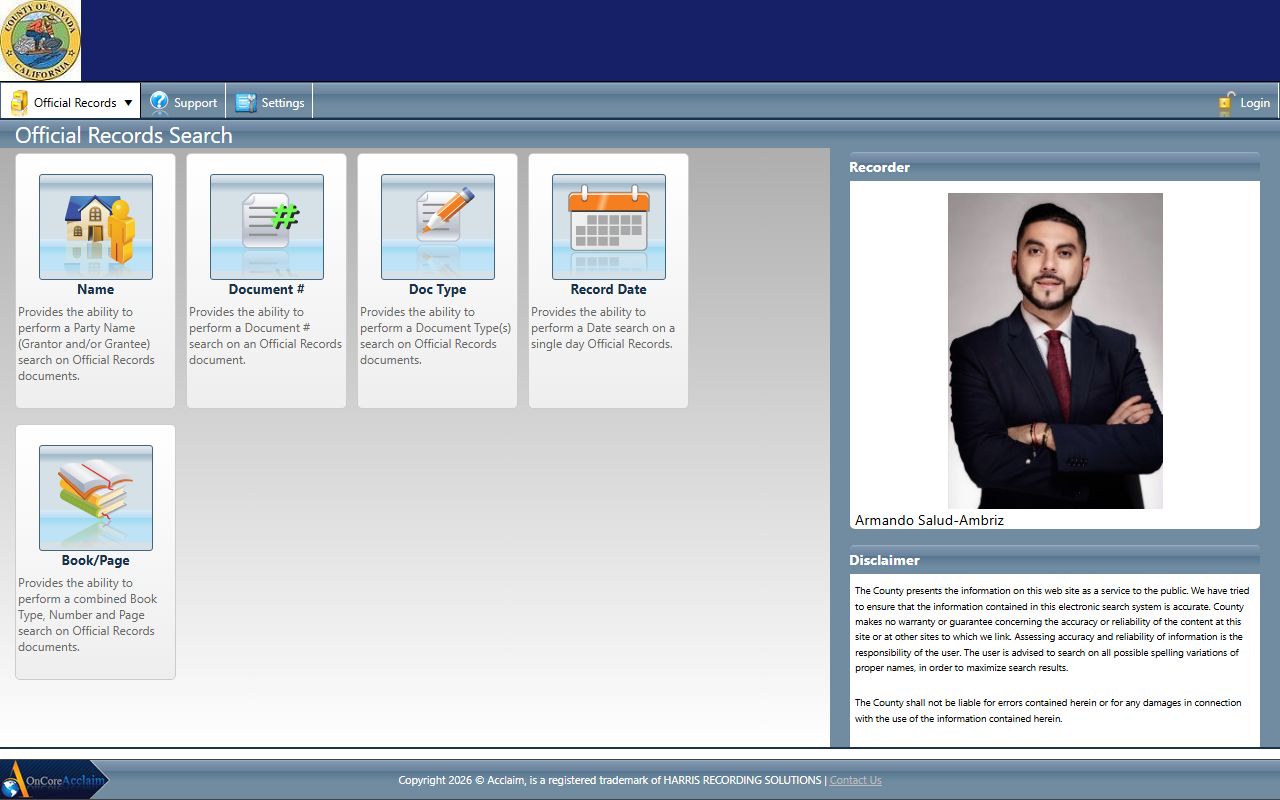
To search by name, type the last name first, then the first name. The results show a list of all matching documents with recording dates and document numbers. Click on a result to see more details like parties involved, book and page numbers, and document type. The index may be free to view but you might have to pay to see full document images or order copies.
Electronic recording is available in Nevada County through certified vendors. Title companies and law firms use eRecording to submit deeds without mailing paper or driving to Nevada City. The documents are reviewed by staff just like paper filings. Most eRecordings process faster than mail, often within a day or two. The California Attorney General oversees eRecording through the Electronic Recording Delivery System program which certifies vendors and sets security standards.
Fees and Transfer Tax
Recording fees in Nevada County follow the standard California structure set by California Government Code Section 27361 which caps the base fee at $10 for the first page and $3 for each additional page. Counties may add fees for fraud prevention, affordable housing under SB2, and other programs. A typical deed costs around $14 to $20 for the first page plus $3 per extra page.
If your deed involves a real estate transfer with a purchase price, add the $75 SB2 housing fee. This fee funds affordable housing under the Building Homes and Jobs Act. The maximum is $225 per document. Documentary transfer tax is 55 cents per $500 of the sale price or consideration. This is the standard rate under California Revenue and Taxation Code Section 11911 which sets the tax at $0.55 for each $500 or fractional part thereof when consideration exceeds $100.
Copy fees are separate from recording fees. A plain copy costs a few dollars per page. Certified copies cost more because they include the county seal and signed certification. You need certified copies for court cases or loan applications. Plain copies work fine for personal reference or title research.
Common Deed Types
Grant deeds are the standard form for property sales in Nevada County. When you buy a home or land, the seller gives you a grant deed. This type carries implied warranties under California law. The seller promises they own the property, have not sold it to anyone else, and there are no hidden liens besides those listed in the deed. These warranties come from California Civil Code Section 1113 which defines what legal promises the word "grant" includes.
Quitclaim deeds transfer property with no warranties or promises. The grantor just gives up whatever interest they have, if any. People use these for family transfers, divorce settlements, or fixing title defects. If you inherit property with siblings and want to give them your share, a quitclaim deed handles that. Or if an old deed has a spelling error in your name, you can quitclaim it to yourself with the correct spelling.
Deeds of trust appear in the index when you get a mortgage. This document gives the lender a security interest in your property. If you stop paying, they can foreclose. When you pay off the loan, the lender files a reconveyance deed to release their claim. Both documents are recorded so anyone searching the title can see the loan history.
Other documents include liens from unpaid taxes or contractor bills, easements that let utility companies or neighbors cross your land, and covenants, conditions, and restrictions that tell you what you can and cannot do with your property. All of these affect your title and show up in searches.
California Property Transfer Law
All real property transfers in California must be in writing. California Civil Code Section 1091 requires that an estate in real property can be transferred only by operation of law or by an instrument in writing subscribed by the party disposing of the same. Oral agreements do not count. You need a signed, written deed to transfer land.
Recording protects you from later competing claims. California follows a race-notice system under California Civil Code Sections 1213-1214 which provides that every conveyance recorded is constructive notice to subsequent purchasers and mortgagees. If two people claim to own the same property, the first one to record usually wins. Recording puts the whole world on notice of your ownership.
Nearby Counties
If the property you need is not in Nevada County, try these neighboring counties: