
Find Napa County Deed Records
Napa County deed records go back to 1848 and are kept by the Recorder-Clerk office in the city of Napa. You can search their online database for free at any time. The system has records from 1848 to the present. Most people search by the names of buyers and sellers or by document number. The office sits at 1127 1st Street, Suite A, and you can reach them at 707-253-4247 or via email at recorder-clerk@countyofnapa.org. Napa County is known for wine country and high-value vineyard properties. Many deeds involve agricultural land, wineries, and estates spread across the valley floor and hillsides.
Napa County Quick Facts
County Recorder-Clerk Office
The Napa County Recorder-Clerk office handles all property document recordings. Their address is 1127 1st Street, Suite A, in the city of Napa. Call them at 707-253-4247 or send email to recorder-clerk@countyofnapa.org. They process deeds, deeds of trust, liens, and other land documents that establish or change property ownership.
When you record a deed in Napa County, staff check it for proper formatting. California law requires specific margins, clear signatures, and correct notarization. If your deed meets these rules, they stamp it with the official date and time, give it a document number, and add it to the public index. This makes your deed part of the permanent record that anyone can search online or in person.
Napa County has kept land records since 1848 when California was still a Mexican territory. Early deeds are on paper and stored in bound volumes or on microfiche. Modern records are digital and searchable through the online database. If you need to see an old deed from the 1800s or early 1900s, you may need to visit the office in person or request copies by mail. Staff can help locate old files but cannot give legal advice about property ownership or how to fill out forms.
The office is open during regular business hours on weekdays. They close for county holidays. If you need to record a deed on a holiday, some title companies offer electronic recording through certified vendors. The document gets submitted electronically and processed the next business day when staff return to work.
Online Deed Search
Napa County provides free online access to their official records database at https://services.countyofnapa.org/OfficialRecords where you can search from 1848 to the present day. Search by grantor name, grantee name, or document number. The system shows you when each document was recorded and what type it is.
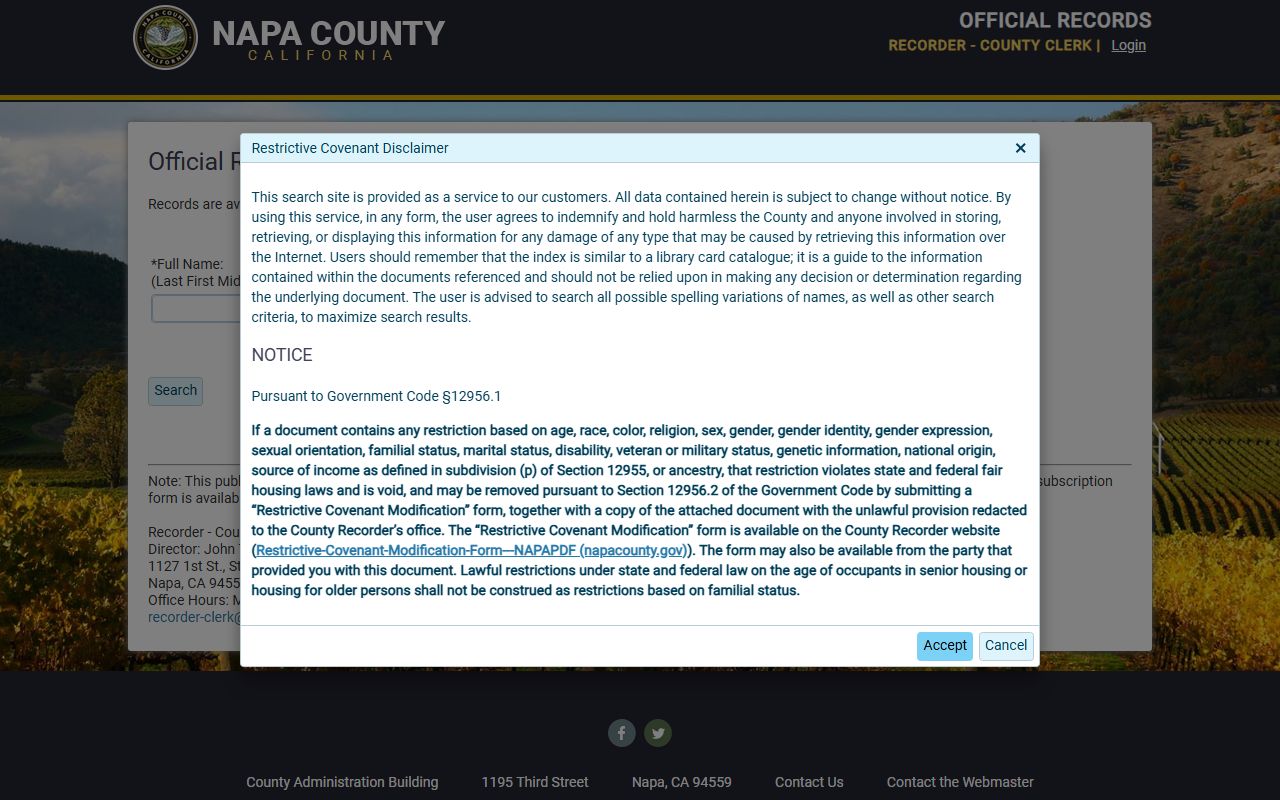
To find a deed by name, type the last name first, then the first name. The search results show a list of all matching documents with recording dates and document numbers. Click on a result to see more details like the parties involved, book and page numbers, and document type. This index information is free to view.
If you need a copy of the full document, you can order it through the county or visit the office in person. Certified copies come with the county seal and a signed statement from the recorder. You need certified copies for legal proceedings or mortgage applications. Plain copies are fine for personal reference or research.
Electronic recording is available in Napa County through approved vendors. Title companies and law firms use this service to submit deeds without mailing paper or driving to the office. The recorder staff review eRecordings just like paper documents and either accept or reject them based on formatting. Most electronic submissions process faster than mail. The state Attorney General oversees electronic recording under California's Electronic Recording Delivery System program which certifies vendors and sets security standards.
Fees for Recording Deeds
Recording fees in Napa County follow the standard California structure. The base fee is set by California Government Code Section 27361 which states the fee shall not exceed $10 for the first page and $3 for each additional page. Counties can add fees for specific programs like fraud prevention or affordable housing under SB2. Expect to pay around $14 to $20 for the first page depending on which fees apply, plus $3 for each extra page.
If your deed involves a real estate transfer with a purchase price, you also pay the SB2 housing fee of $75 per transaction. This fee was added by the Building Homes and Jobs Act to fund affordable housing programs. There is a cap of $225 per document, so even large multi-parcel transactions do not pay more than that.
Documentary transfer tax in Napa County is 55 cents per $500 of the sale price or consideration. This is the standard rate set by California law. Some counties and cities add extra transfer taxes on top, but Napa County appears to use the base rate only. If your property sold for $600,000, the transfer tax is about $660 calculated as $600,000 divided by 500, times 0.55.
Copy fees are lower than recording fees. A plain copy costs a few dollars per page. Certified copies cost more because staff must add the county seal and a signed certification statement. Online copy orders may include a convenience fee. In-person requests at the counter usually cost less but require a trip to the Napa office.
Types of Deeds Recorded
Grant deeds are the most common type in Napa County. When you buy a house or vineyard, the seller gives you a grant deed. This type of deed carries implied warranties under California law. The seller promises they have not sold the property to anyone else and that there are no hidden liens except those mentioned in the deed. These implied covenants come from California Civil Code Section 1113 which defines what legal promises the word "grant" includes.
Quitclaim deeds transfer property with no warranties or promises. People use these for family transfers, divorce settlements, or clearing title defects. If you inherit property with your siblings and want to give them your share, a quitclaim deed does that. Or if an old deed has your name spelled wrong, you can quitclaim the property to yourself with the correct spelling. The grantor just gives up whatever interest they have, if any.
Deeds of trust show up when you take out a mortgage or loan secured by real property. This document gives the lender a security interest in your land. If you do not pay, they can foreclose. When you pay off the loan, the lender files a reconveyance deed to release their claim. Both the original deed of trust and the reconveyance are recorded so anyone searching the title can see the loan history.
Other recorded documents include liens, easements, and CC&Rs. Liens come from unpaid taxes, contractor bills, or homeowner association dues. Easements let others cross your land for things like utility lines or access roads. Covenants, conditions, and restrictions tell you what you can and cannot do with your property in certain subdivisions. All of these affect your title and appear in the recorder index.
California Property Transfer Law
All real property transfers in California must be in writing. California Civil Code Section 1091 requires that an estate in real property can be transferred only by operation of law or by an instrument in writing subscribed by the party disposing of the same. You cannot transfer land with a verbal agreement or handshake. It must be a signed, written deed.
Recording protects you from later competing claims. California has a race-notice statute at California Civil Code Sections 1213-1214 which provides that every conveyance recorded is constructive notice to subsequent purchasers and mortgagees. If someone else also claims to own your property, the first person to record their deed usually wins. Recording puts the whole world on notice of your ownership.
The recorder must accept any document that meets formatting standards. California Government Code Section 27201 says the recorder shall accept for recordation any instrument authorized by statute upon payment of proper fees and taxes. They check margins, signatures, notarization, and fee payment. They do not verify that your deed is legally valid or a good idea. That is up to you and your attorney before recording.
Nearby Counties
If the property you need is not in Napa County, try these neighboring counties: